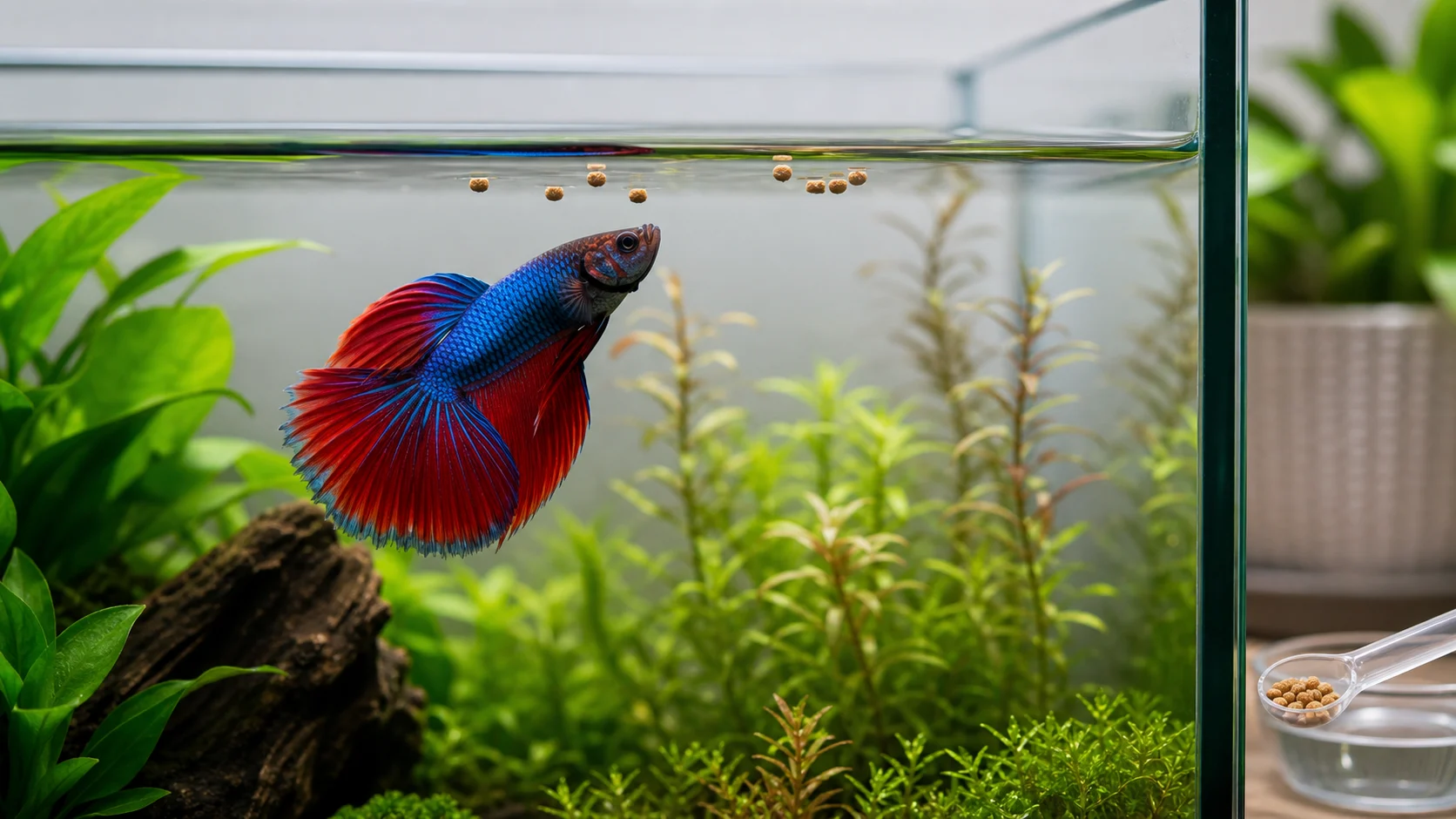

Quick answer: what to do after overfeeding a betta
Remove all uneaten food, do not add another meal immediately, and test ammonia and nitrite. Keep the water warm and stable, then return to smaller portions once the fish is active, swimming normally, and interested in food.
Do not make several major changes at once. The immediate priorities are removing waste, checking water quality, and watching the fish for swelling, balance problems, breathing changes, or worsening weakness.
Signs of an overfed betta fish
Common signs include food left on the surface or substrate, a rounded belly after eating, cloudy water, rising waste, messy gravel, or a betta that suddenly ignores the next meal.
A betta may still beg for food after eating. Begging does not prove that the fish needs another portion.
First checks after an overfeeding mistake
Check whether food is still visible and remove it with a net, siphon, or turkey baster used only for the aquarium. Test ammonia and nitrite; both should read 0. Confirm the water temperature and observe appetite, breathing, swimming balance, scales, and activity.
If ammonia or nitrite is present, follow careful water-quality steps rather than relying on fasting alone. Extra food can affect the aquarium even when the fish does not eat every piece.
Overfeeding vs normal post-meal fullness
Mild roundness directly after a meal may settle as the fish digests. It is more consistent with simple overfeeding when the betta remains alert, breathes normally, swims normally, and improves rather than becoming progressively swollen.
Repeated bloating, refusal to eat, abnormal waste, sinking, floating, or loss of balance deserves a broader check. Feeding history is useful, but it is not a diagnosis by itself.
Overfeeding vs bloating, swim bladder trouble, or dropsy
Not every swollen betta is simply overfed. Bloating can also be associated with constipation-like digestive trouble, eggs in a female, poor water quality, internal disease, or other health problems.
Pineconing scales, rapid or severe swelling, gasping, marked lethargy, inability to stay upright, or worsening symptoms are more concerning than mild post-meal fullness. Do not assume those signs will resolve only by withholding food.
How long should you watch an overfed betta?
Watch closely over the next day while keeping water stable and avoiding another oversized meal. Improvement in belly size, activity, swimming, and appetite is reassuring.
There is no universal recovery clock. If swelling worsens, the fish becomes weak, breathing changes, or balance is lost, seek advice from an aquatic veterinarian or qualified fish health professional.
Water quality after overfeeding
Uneaten food and extra waste can raise ammonia, nitrite, and nitrate, especially in a small or uncycled tank. Clear water does not guarantee safe chemistry.
Use test results to guide partial water changes. Avoid replacing all the water, scrubbing the entire tank, or replacing filter media at the same time, because sudden instability can add more stress.
Safer feeding portions
Feed a small portion the betta can finish promptly and remove leftovers. Pellet size and calorie density vary, so one fixed pellet number does not fit every food.
Use body condition, appetite, waste, and water quality together. A consistent feeding schedule with measured portions is safer than adding food whenever the betta approaches the glass.
Common mistakes after overfeeding
Common mistakes include adding different foods to tempt the fish, assuming every swollen belly is harmless, skipping water tests, performing a complete tank clean, or repeatedly fasting without fixing oversized daily portions.
A short feeding pause may be reasonable after a clear one-time mistake, but fasting does not correct ammonia, nitrite, cold water, or a serious health problem.